Category: Community

  • Trust The Process: 2019 Harvard LILFest

    Earlier this month, I was invited to attend the Harvard Library Innovation Lab’s 2019 LILFest. Sponsored by the lab and Harvard Law Library, and hosted by the Dorchester Art Project, It was a refreshing deviation from my normal day-to-day. Throughout the event we heard speakers from the lab and the broader community sharing PechaKucha-style talks on a wide-range of current interests at the intersection of libraries, technology, and the analog/digital divide.

    Jack Cushman from Harvard LIL kicking off the morning talks.

    As with attending events for the first time, I had no idea what to expect. But during afternoon reflections, I began to find some signal in the noise.

    The messy work of creating culture

    When we look at the exemplary workplace cultures in society, people who are a part of it have a shared optimism about the future, an unfettered confidence in their potential, and a tangible chemistry. After speaking with Adam Ziegler, Executive Director of LIL, it became obvious that this was the case. His team comes from a wide variety of backgrounds and careers – from law, tech, librarianship and beyond – joined together by a shared culture to build a better future.

    I think about the task new library leaders have when brought in to a turnaround environment and how the top priority should always be focusing on the culture. Nothing else really matters if the organization isn’t bought into a shared purpose and vision.

    The disorienting thing about culture-building is that the process can be ugly but the end result is beautiful. I’d imagine Adam and his team have had days where taking risks and charting new courses seemed unwise. But having been a part of this year’s retreat, I saw a community of people enjoying each other’s company working towards something larger than themselves. In this environment, no task or project seems too big, and the shared trust is present to take on risks that are necessary for innovation. There’s much to be gleaned here.

    Innovation happens when we try new things poorly

    If you’re not a part of an innovative culture, and your exposure to innovation has only been second or third-hand, it may seem that companies that innovate operate like Starship Enterprise – where everything is neat, sleek, orderly and futuristic. Having been a part of one at 4.0 Schools – an education incubator in New Orleans responsible for much of the innovation taking place in education reform today – that this is not the case. There’s a lot more failure than success.

    Ben Steinberg from Harvard LIL demoing a homemade synth machine.

    The main difference is the shared willingness to try and fail, and the expectation to quickly respond with improvements. Creating a space for this to take place is the key ingredient for innovation. This will become increasingly important for new library leaders who are asked to work wonders with few resources and a team of people who aren’t used to this.

    When your product is your people

    Being in this space with the LIL team made me think about the importance of people. Venture capitalists realize this when they decide to fund a team that drastically changed their original project to work on something different. They are investing in the people – not the current idea that brought them together. Technology CEOs realize this when they acquire companies with no intention on using what they built, but deploying that team of people who are gifted onto other problems, also known as an “acqui-hire” (hiring via acquisition). They too are investing in the people – not the company that brought them together.

    The inverse of this is also true. I had a call today with a manager at medium-sized regional academic library that left a strong impression on me. When talking to them about the future of work in libraries, they took on a gatekeeper persona, and cut the call off when I inquired more about their work and what they do. This brought me back to my days at Ex Libris selling the Alma library management system. In 2012-13, if you told a systems librarian that you had a were going to save their institution money by moving their servers to the cloud, that person had a decision to make: they could either say “About time! I’ve always wanted to put skills X,Y,Z to use. Glad I won’t have to manage this hardware anymore.” Or they could say “you mean, I won’t have any work to do anymore? I don’t think I like you, OR your new application.”

    The same analog can be applied many places. The key difference is the people within our organization, and their perspective towards managing change. Are they at a point in their careers where they feel reinventing themselves is not an option? Do they view a change in the status quo as an exciting opportunity or a dreadful omen?

    The answer to these questions has a great impact on an organization’s ability to navigate the uncharted waters of the next decade. Before any new buildings are built, or new software is implemented, or new initiatives are launched, the culture work has to be addressed. Because at the end of the day, the product we have to offer the world is our people.

  • Skilltype @ ALA Midwinter 2019: Taking the Road Less Travelled

    In typical Skilltype fashion, our presence at ALA Midwinter 2019 in Seattle was non-traditional. Mainly because as a startup, exhibit hall real estate isn’t the most fiscally responsible investment. But also because brands that launch at ALA in the sea of vendors simply to fade into oblivion. Why spend all of that money to cross your fingers in hope that the right people stop by your “little booth that could”, when in actuality the people who stop by just want to know if you’re raffling off an Apple Watch.

    So instead, I saved money, called up some friends, and connected the Skilltype way.

    Thursday: Gonzaga Skilltype Kickoff

     Icy sidewalk en route to Gonzaga’s Foley Library for their official Skilltype kickoff. January 23, 2019.
    Icy sidewalk en route to Gonzaga’s Foley Library for their official Skilltype kickoff. January 23, 2019.

    Over the course of the day, we had about 40-50 people from the library and various departments across campus such as Organizational Development and HR, Office of Diversity, and the office of research attend sessions to learn about the future of work, and how Skilltype can help prepare their organizations for 2030.

    After the session, I flew back across the Cascades to Seattle, and started preparing for the weekend’s festivities.

    Friday: Skilltype Happy Hour @ Amazon HQ

     Waiting on our advisory board member at Amazon’s Oscar building. January 23, 2019.
    Waiting on our advisory board member at Amazon’s Oscar building. January 23, 2019.

    Being in Seattle, I tapped Skilltype advisory board member Julian to see what ideas he had about showing our development partners a special experience while in town. He got us passes to the Amazon Spheres – an alternative workspace for Amazon employees who need a creative boost during the week. The 5-story indoor rainforest was an inspiration of what the future of work could feel like.

     Skilltype development partners touring Amazon Spheres. January 23, 2019.
    Skilltype development partners touring Amazon Spheres. January 23, 2019.

    After the tour ended, we met up with our beta testers and some new friends to kickback. This was one of the first times our development partners connected in this context. The energy around the Skilltype movement was tangible.

     Skilltype dev partners connecting at happy hour. January 23, 2019.
    Skilltype dev partners connecting at happy hour. January 23, 2019.

     Skilltype community members connecting at happy hour. January 23, 2019.
    Skilltype community members connecting at happy hour. January 23, 2019.

    Saturday: Skilltype + BCALA

    Spent the afternoon with the BCALA delegation sharing my personal story in libraries and the road to Skilltype. Was very interesting to have my personal and professional identities converge since they usually don’t. I believe this is another tenet of the future of work – being able to bring your full self to the workplace. To model it was refreshing and nerve-wracking at the same time.

    Sunday: Skilltype Product Update

     Skilltype beta testers and working group members discussing our current roadmap. January 25, 2019.
    Skilltype beta testers and working group members discussing our current roadmap. January 25, 2019.

    On Sunday morning, we connected with our beta testers and working group leaders to get stuff done. One of the biggest decisions that came our of this talk was to approach Teams differently on the platform. Eleanor Cook commented on the difficulty of organizing department nomenclature across institutions to the platform. Every institution calls teams something different. Unlike other pieces of organizational data that are controlled with vocabularies, Bohyun Kim from recommended that other systems on campus do a good job at structuring groups of people. Skilltype can be the place where we can create ad-hoc, dynamic groups simply used for internal purposes. We immediately agreed and brought the idea back to the team to update the roadmap.

    It was also interesting to have the current and previous heads of three separate professional associations in the room discussing Skilltype’s role in the professional association landscape. I’m really excited about where this conversation will go, as there seems to be a need for something more; something different.

  • Future of Work Meetup: NOLA

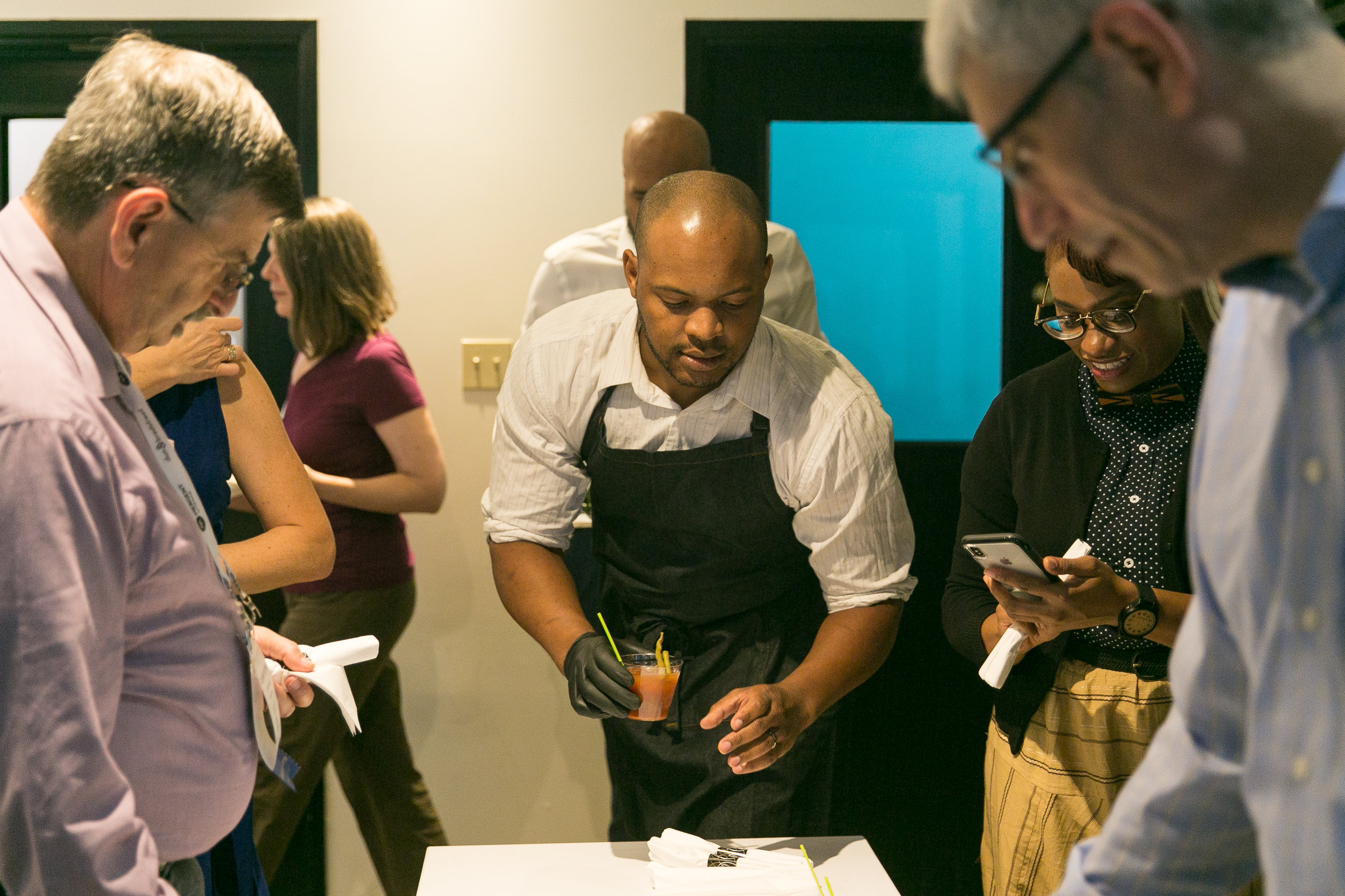
     Chef Aaron Washington of Local Menu NOLA. Photo by  Harlin Miller .
    Chef Aaron Washington of Local Menu NOLA. Photo by Harlin Miller .

    We wanted to do something different. Typical conference events attract people with the food and not the content. But we wanted both. Being our hometown we had a little home court advantage. It didn’t hurt that our office space was walking distance from the convention center.

    I called a friend and local chef to see if he was available to give our clients and users a taste of New Orleans. I contacted my favorite author to see if she would join us somewhat last minute, and while she couldn’t she offered to record some remarks on video to help us start the evening off right.


    Our panelists came from Quartolio (an artificial intelligence company for surfacing research), University of Rhode Island Libraries, and the Offor-Walker Company (an executive search firm with a focus on creating diverse talent pipelines).

    We wanted to have a dialog on the intersection of diversity/equity/inclusion and technology, discussing how DEI work can be impacted by design and software, for better or for worse.

    Dr. Safiya Noble, in the video above, recently published a book titled Algorithms of Oppression which investigates the role social companies play in propagating racism and oppression through their business models and product design. Her research highlights the opportunity and responsibility we have as software companies to interrogate our decisions and the impact they have on everyday citizens.

    At Skilltype, we ask ourselves on a regular basis, “Do people need what we have to offer?”, “Are we making the world better than how we found it?”, “Who receives the most benefit from our work: people or shareholders?”

    We believe technology can play a positive role in the future of work, but not without a culture of honest and transparent conversations about the inequities that plague the workplace of today. If you’re interested in joining our next future of work meetup, contact us at email@skilltype.com with the subject #FOWM2.