• From Libdot to Skilltype

    Last month we decided to retire the brand that got us started. While I believe this is right for a number of sound reasons I’ll discuss here, no one should take away that Libdot didn’t have a fond place in our hearts.

    In the words of Boyz II Men, “How do I say goodbye to what we had?”

    We started out on this journey with a simple problem statement: Talent management in libraries is broken. Technologically, I’ve always been interested graph databases. Being in on the ground in Palo Alto when Facebook first opened their platform to developers, I remember the excitement around what graphs can do to surface relationships. Their social graph, and LinkedIn’s newer economic graph, along with Google’s Knowledge Graph, made me wonder why libraries don’t have their own graph. “Libdots”, were objects from the library ecosystem that existed on the graph: people, organizations, products/services, and more. But having conversations with CIOs, library leaders who straddle offices of research, iSchool deans and others, made me realize that the real-world ecosystem libraries operate in may be larger than I understood.

    We’ve since developed a theory of change around solving it which focuses on skills. Along the way a variety of people and perspectives have challenged our thinking for the better. Below are three of the more meaningful lessons we’ve learned outside of the obvious feedback like “Is Libdot another Springshare product?”

    Variance among institutional cultures impedes collaboration. Skills are an objective common denominator.

    Since 2010, I’ve met with over 500 library leaders around the world. And the amount of diversity of titles, roles, department names and employment classifications is rich. For example, how many titles exist for a Technical Services leader in a library? With nearly a dozen options describing the person’s rank (e.g. head, associate director, associate university librarian, manager, etc…), plus another dozen variations on the department name itself, it’s difficult to measure what makes a good technical services leader. For a software platform designed on the premise of collaborative talent management, this poses a significant challenge (and opportunity). At Skilltype we have a bias towards clean, structured, machine readable metadata to help us describe ourselves, our work and our organizations. Getting this right opens up unprecedented opportunities for collaboration, as people and organizations have a more atomic makeup than our parochial culture would suggest. Our new name speaks more directly to the importance of this idea in our work than our last.

    Lines between libraries and other departments are being blurred. Skills reveal the true relationships among teams.

    Secondly, libraries and library workers are now tasked with assignments that fall outside of the traditional scope of librarianship. These professionals are increasingly contributing to teams within IT, Offices of Research and beyond. Departmental structures are at their most fluid as organizations experiment with merging, re-scoping, and outsourcing work across and outside campus. One of the more controversial examples is around the term library itself being rethought on many campuses. New buildings being named everything from “Learning Commons” to “Innovation Hubs”. This evidence and more pushed us to think more holistically about the information profession and our relationship to it.

    With over 80 million skills-based data points to collect, we haven’t even begun to understand the information profession.

    We’re cautiously optimistic on the power of machine learning for the profession. But there’s good amount of data cleanup and culture shifting to be done before we begin jamming data into an algorithm. Researchers and practitioners are concluding that AI is not smart enough to reverse trends that we now conclude have negative impact on our staff and organizations. While acknowledging these risks of AI, we also believe that to build the future of work we have to move beyond arbitrary measurements of fit. Why certain people get hired or fired, promoted or demoted is 100% subjective to the persons involved in making the decision. How managers measure performance varies from organization to organization, and even manager to manager. CVs, performance evaluations and interviews are full of insights that capture the essence of the information profession. Distilling this into a measurable, predictable format positions us to understand the patterns that drive career development across our profession.

    We think skills data is a good starting point for building the bridge to the 2030 information workplace. We’re grateful for the support of our early partners as we do our part in the community to help figure this out.

    “What’s your Skilltype?”

    So while we say farewell to Libdot, we welcome Skilltype. Maybe this new term can become the way we communicate who we are professionally.
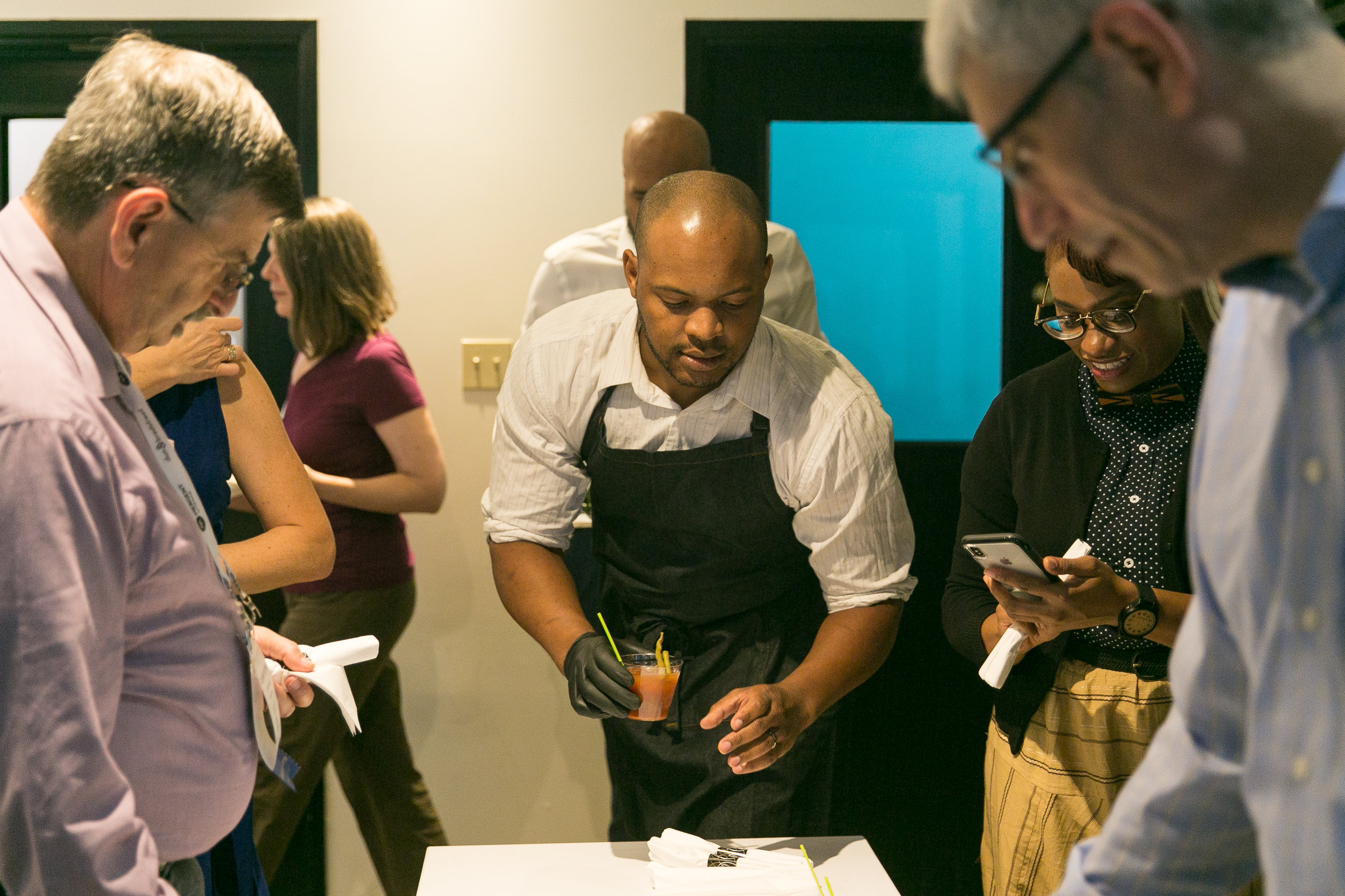
  • Future of Work Meetup: NOLA

     Chef Aaron Washington of Local Menu NOLA. Photo by  Harlin Miller .
    Chef Aaron Washington of Local Menu NOLA. Photo by Harlin Miller .

    We wanted to do something different. Typical conference events attract people with the food and not the content. But we wanted both. Being our hometown we had a little home court advantage. It didn’t hurt that our office space was walking distance from the convention center.

    I called a friend and local chef to see if he was available to give our clients and users a taste of New Orleans. I contacted my favorite author to see if she would join us somewhat last minute, and while she couldn’t she offered to record some remarks on video to help us start the evening off right.


    Our panelists came from Quartolio (an artificial intelligence company for surfacing research), University of Rhode Island Libraries, and the Offor-Walker Company (an executive search firm with a focus on creating diverse talent pipelines).

    We wanted to have a dialog on the intersection of diversity/equity/inclusion and technology, discussing how DEI work can be impacted by design and software, for better or for worse.

    Dr. Safiya Noble, in the video above, recently published a book titled Algorithms of Oppression which investigates the role social companies play in propagating racism and oppression through their business models and product design. Her research highlights the opportunity and responsibility we have as software companies to interrogate our decisions and the impact they have on everyday citizens.

    At Skilltype, we ask ourselves on a regular basis, “Do people need what we have to offer?”, “Are we making the world better than how we found it?”, “Who receives the most benefit from our work: people or shareholders?”

    We believe technology can play a positive role in the future of work, but not without a culture of honest and transparent conversations about the inequities that plague the workplace of today. If you’re interested in joining our next future of work meetup, contact us at email@skilltype.com with the subject #FOWM2.

  • What a Dinner Experiment Taught Me About School

    Photo: Tony Zanders

    “The octopus should’ve been prepared like ceviche. It was too warm for me. I give it a two,” I shared with the group. “That’s funny, it was actually my favorite course so far, especially with that white wine pairing,” replied Jonathan. His rating for our first course at Dinner Lab, a pop-up restaurant experience that enables up-and-coming chefs to get feedback on their work, was probably higher than mine for the first course. But in the midst of our chatter, it dawned on me how human it felt to discover new things, learn more about yourself and the people around you, and play an active role in my education.

    4.0 took our staff, along with Launch Cohort 9 to a Dinner Lab experience in New Orleans’ Central City neighborhood this Summer. It was my first. The underground supper club was founded in 2010 by 4.0’s previous Director of Entrepreneurial Investment Brian Bordainick, and has since expanded to 10 cities, grown to over 50 staff, and raised over $2 million in seed funding. The exclusivity of their limited memberships ensures every seat is filled each night, while the hands-on dining experience keeps diners engaged and off of their cell phones. In between each of the 5-7 courses, diners take time to complete feedback cards that compile specific data to help the chef improve various aspects of their meals.

    I felt the joy of a new student — excited to discover new ideas and give feedback with the confidence that the teacher (or chef) would appreciate my perspective. Sharing this experience with people from different backgrounds and upbringings than mine made the learning exponentially better. Each course served as our anchor throughout the evening, oscillating between food and feedback, taking 2-3 minutes to complete our cards after each course. But the stories that were told as we waited for the next dish was where the real magic happened.

    Liz Cole, our video producer, shared stories of a childhood in Antlers, Oklahoma — a rural midwestern town with less than 2,500 people. Her fiancee Ryan, a teacher at KIPP Renaissance in New Orleans, described things that made growing up in Austin, Texas similar to New Orleans. While we waited for the first course, 4.0’s Education Pioneer fellow and Minnesota native Anthony Berglund told us stories about the “Juicy Lucy” that the Twin Cities is known for. And Rooted School founder Jonathan Johnson added a layer of humor and sophistication to our party by announcing each course and wine pairing as the waiter left.

    My wife and I were the only New Orleans natives in the group. We reflected on how energizing it felt to share a window into our experience growing up here, and for others to be genuinely intrigued by our perspective. Going home that evening feeling more informed, more in touch and more aware, I couldn’t help but to wonder if this is what school should be like: a culturally-responsive, participatory, informative, communal experience — one that leaves its students wanting more.